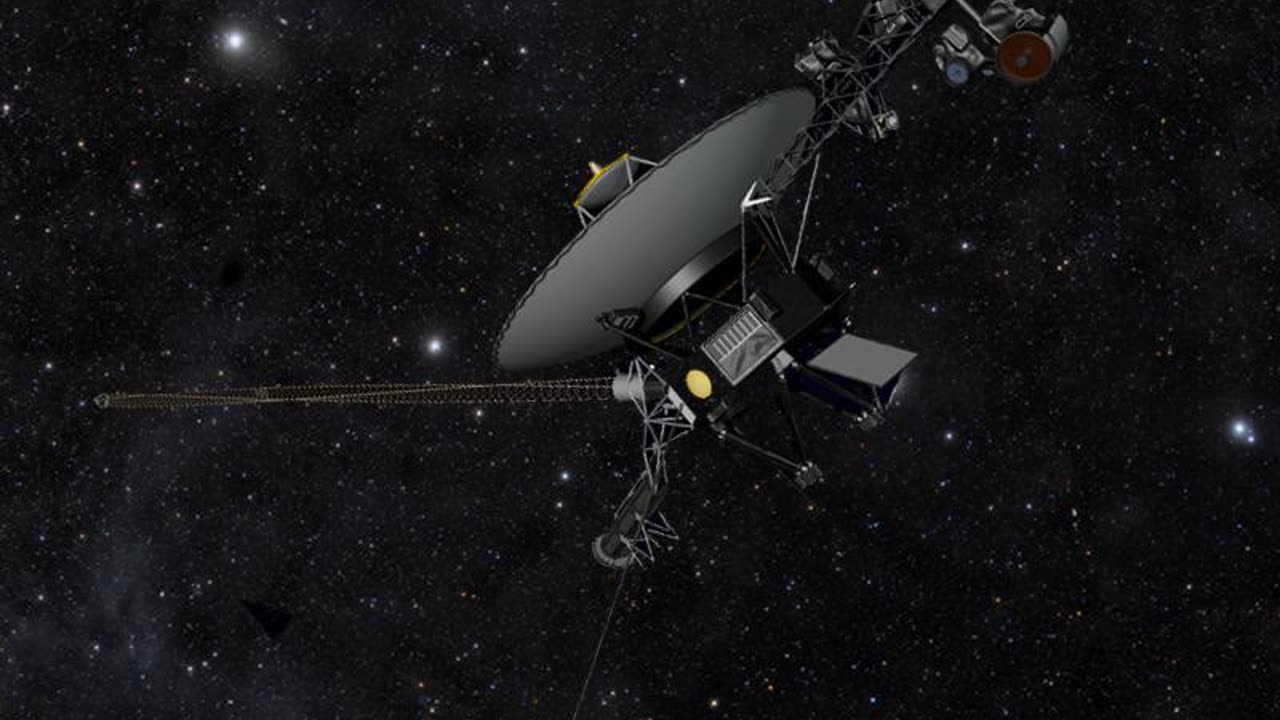
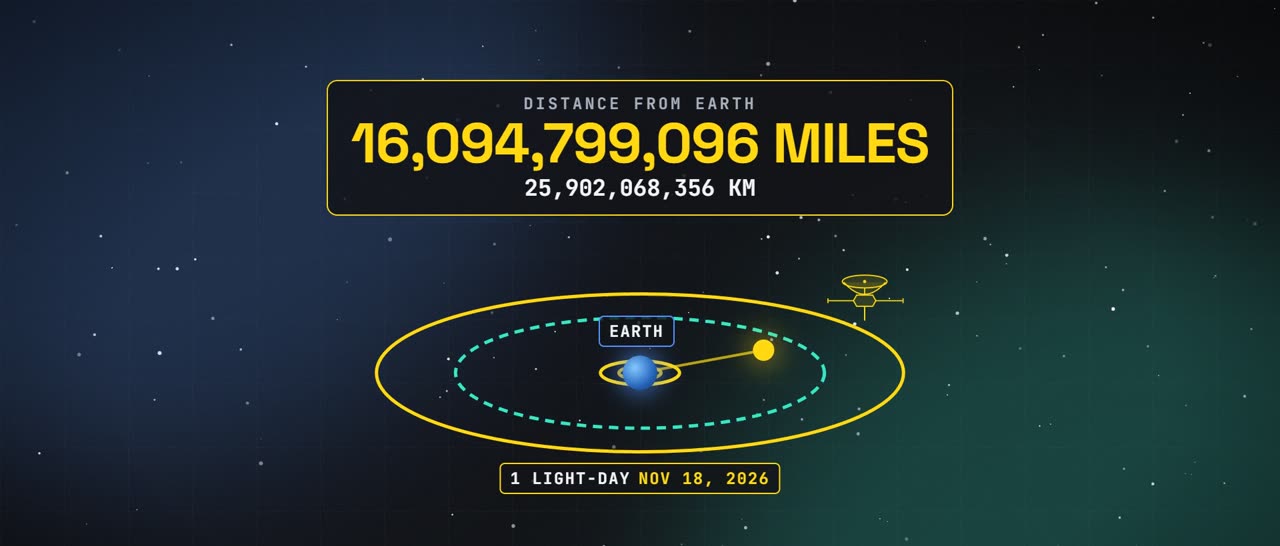
Forty-nine years after launch, a spacecraft built to study Jupiter and Saturn was still sending data home — and on 18 November 2026 it crossed a line no human-made object had reached before. NASA calculated that Voyager 1 would be one light-day from Earth at 5:16:07 a.m. EST (2:16:07 a.m. PST) that day: about 16.1 billion miles, or 25.9 billion kilometres.
What a “light-day” actually is
Despite the name, a light-day measures distance, not time. It is how far light travels in 24 hours — NASA puts it at 16,094,799,096 miles (25,902,068,356 kilometres). For scale, NASA notes that light crosses the average distance to the Moon in about 1.3 seconds and reaches us from the Sun in about eight minutes and 20 seconds.
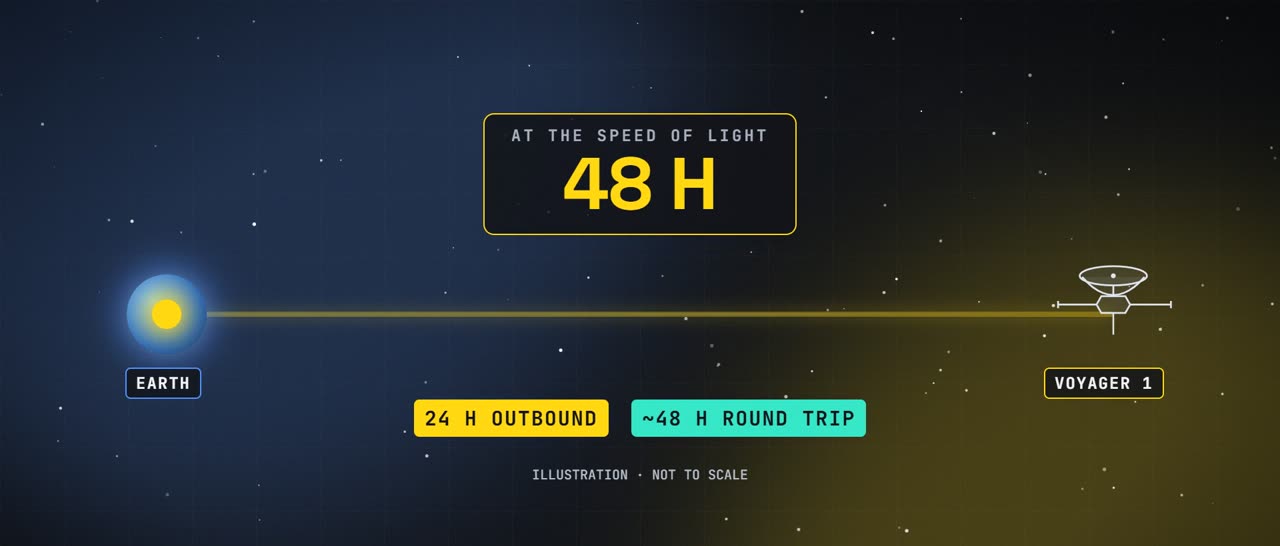
Crossing the line does not change anything physically for the spacecraft. What it changes is communication. At one light-day, a radio signal from Voyager 1 needs a full 24 hours to reach Earth, and a command from Earth needs 24 hours to get there. A round trip — a message and its reply — takes about 48 hours.
Voyager project manager Suzanne Dodd put it plainly on NASA’s mission page: “If you want to say ‘hello’ to Voyager, you send your message and then you go home and you wait two days before you finally get a response.”
How it got this far
NASA launched Voyager 1 on 5 September 1977, two weeks after its twin, Voyager 2. As originally designed, the Voyagers were to study Jupiter and Saturn up close. Voyager 1 passed Jupiter in 1979 and Saturn in 1980, then headed out of the plane of the planets. It entered interstellar space — beyond the heliopause, the boundary of the Sun’s bubble of particles and magnetic fields — in August 2012.
It is now cruising at nearly 38,000 miles per hour (61,000 km/h). By NASA’s count, the trip to one light-day took 49 years, two months and 11 days. Voyager 2, on a different path, is on pace to reach the same mark in November 2035.
Inside a 1977 machine
What keeps a spacecraft from the 1970s working at this distance? Not raw computing power.
Computers with kilobytes, not gigabytes
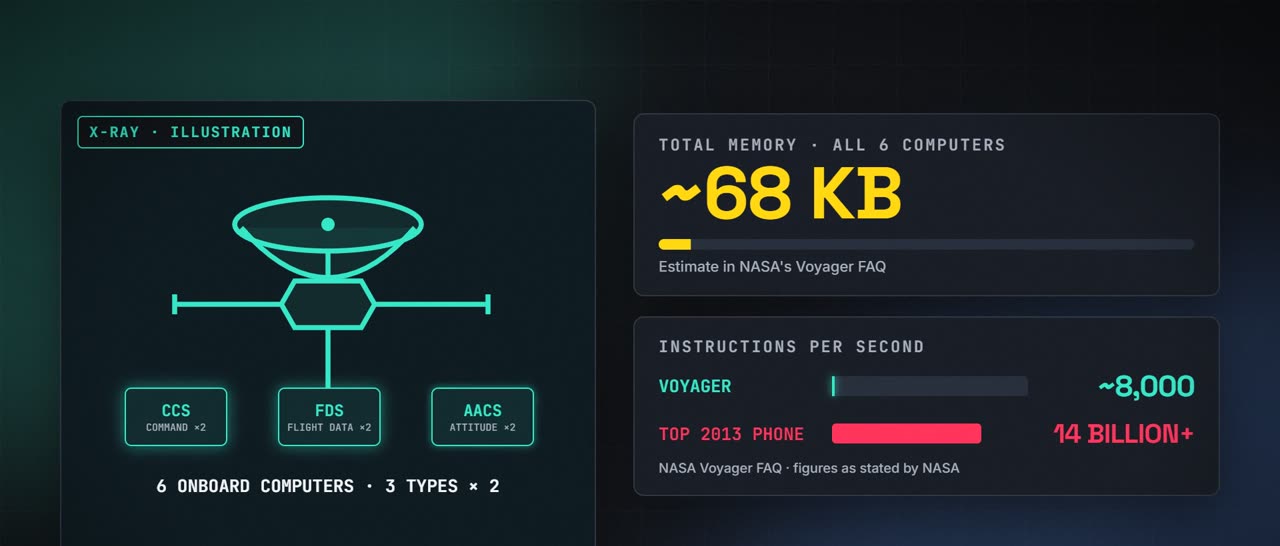
Voyager carries six onboard computers — three types, two of each. NASA’s Voyager FAQ estimates their total memory at about 68 kilobytes. (You will often see “69.63 KB” quoted online; we use NASA’s own estimate.) The FAQ says Voyager’s computers process about 8,000 instructions per second — and that even a top smartphone from 2013 handled more than 14 billion.
Plutonium power that fades every year
Voyager is too far from the Sun for solar panels. Instead, radioisotope thermoelectric generators turn the heat of plutonium’s natural radioactive decay into electricity. That output falls by about 4 watts every year, NASA says, so engineers have switched off heaters and other systems one by one and turned off instruments to save power. NASA’s status table lists Voyager 1’s cameras off since 1990 and its low-energy charged particle instrument off since April 2026 — but some instruments are still running.
Who is listening on Earth
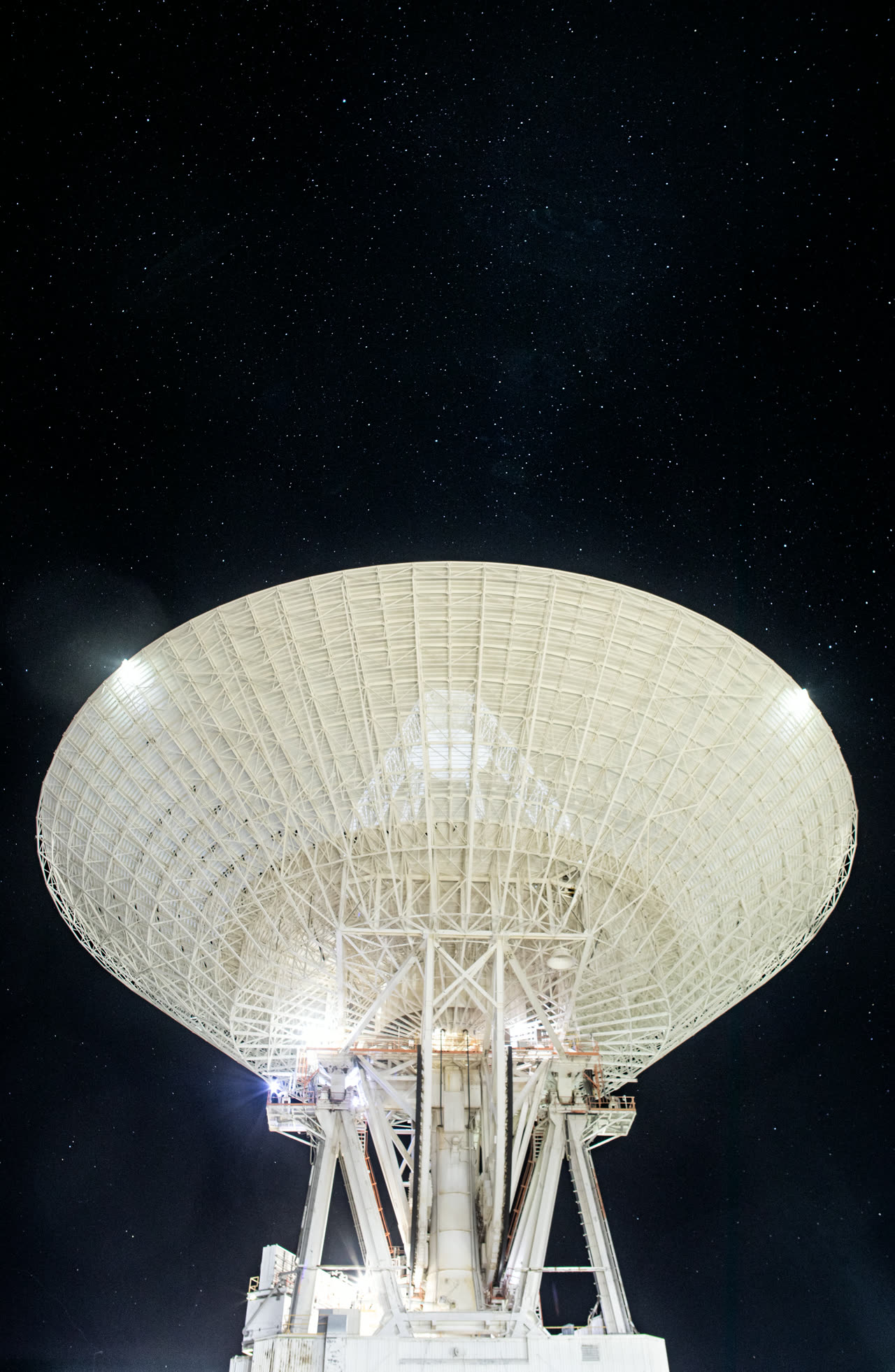
Voyager’s faint signal is picked up by NASA’s Deep Space Network, a set of giant radio antennas at three complexes: Goldstone in California, near Madrid in Spain and near Canberra in Australia. Each site has one huge 70-metre (230-foot) dish — NASA’s largest and most sensitive antennas — and the sites are spread around the globe so a spacecraft never drops below every horizon at once.
How long can it last?
NASA’s FAQ says the two Voyagers could remain within range of the Deep Space Network through about 2036, depending on how much power they still have to transmit a signal back to Earth. Even after the science instruments go quiet, engineering data could keep arriving for some years.
Voyager 1 is heading toward a star called AC+79 3888 (Gliese 445) in the constellation Ursa Minor, NASA says, and will pass within about 1.7 light-years of it — in roughly 40,000 years. It also carries the Golden Record, a 12-inch gold-plated phonograph record with greetings in 55 languages, music and images from Earth.
The small team keeping it alive
Voyager is not run by a large mission-control room any more. The Associated Press reported that a skeleton flight team at NASA’s Jet Propulsion Laboratory in Pasadena sends commands about once a week, with the effort ramping up when problems arise — sometimes with help from retirees who once worked on the project. Project manager Suzanne Dodd, who has worked with the Voyagers since 1984, described the spacecraft to AP as something like weather satellites for interstellar space: almost every day they send back details about the magnetic field, pressure, dust and galactic cosmic rays around them.
It is not trouble-free. AP reported that controllers completed the latest power-saving step in September and then briefly lost contact with the spacecraft in October, and were still working out why. Problems like that are the reason the remaining power budget matters so much: every watt goes to keeping the radio and the most valuable instruments alive.
Voyager 1 also holds one of space exploration’s most famous images. In 1990, from beyond Neptune, it captured the “Pale Blue Dot” — Earth as a single bright speck — before its cameras were switched off to save power and memory for the instruments studying interstellar space.
NASA planned to mark the milestone with a moderated discussion at JPL on 19 November with mission members and NASA leadership, and with a preview of a NASA+ Voyager documentary planned for the mission’s 50th anniversary in 2027.
Why this milestone matters
To mark the milestone, NASA invited people worldwide to flash “VGR” — Voyager’s call sign — in Morse code after sunset on 17 November, a symbolic wave of light. The real achievement, in our view, is simpler: a machine launched in 1977, with about 68 kilobytes of memory and a power supply that shrinks every year, was a full light-day away and still answering.
Sources checked 15–18 November 2026. Distances are NASA figures; illustrations are not to scale.