
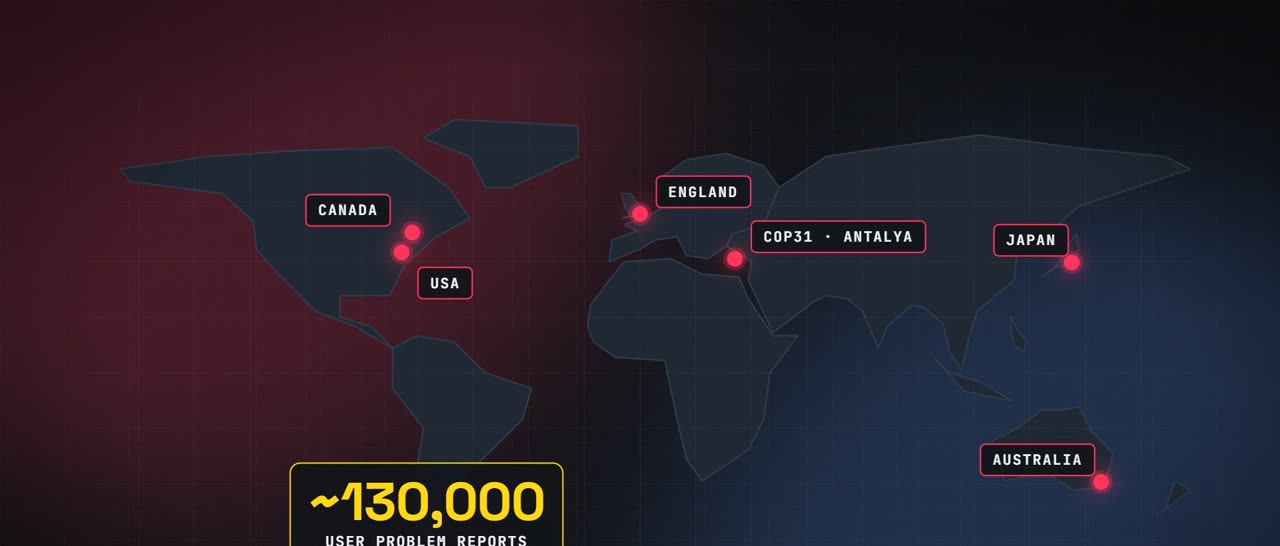
NHS services in England falling back on backup systems and paper records. Participants at the COP31 climate summit in Antalya, Türkiye, struggling to reach their documents. Government agencies from Australia to Japan disrupted. On Thursday, 12 November 2026, Microsoft 365 went down, and the outage tracker Downdetector logged nearly 130,000 user problem reports from 74 countries, The Guardian reported.
When that much breaks at once, the first question is obvious: was it a cyberattack? Microsoft’s own incident updates — and now its preliminary post-incident report — answer it.
What broke, and for whom
More than 430 million people use the affected Microsoft products, according to the BBC and The Guardian. The heaviest damage was to email: Outlook failed for users around the world. Microsoft said features that rely on Exchange Online and email — including parts of Teams and Copilot — were impacted, while most core Teams functions, such as joining calls, meetings and chats, kept working.
The ripple effects were real. NHS bodies in England said local services were turning to alternative measures such as other IT systems or paper records. In Canada, hospitals had trouble with email, and Montreal’s CHUM hospital said appointment requests were affected (Reuters, via CBC).
Was it a cyberattack?
No — according to Microsoft. Its final status on incident MO1550821 was direct: this was “a technical issue not related to cyber or AI / agents”. Earlier updates during the incident also said it had no evidence of malicious activity. That is Microsoft’s account; no captured source we reviewed contradicted it.
Microsoft’s first explanation
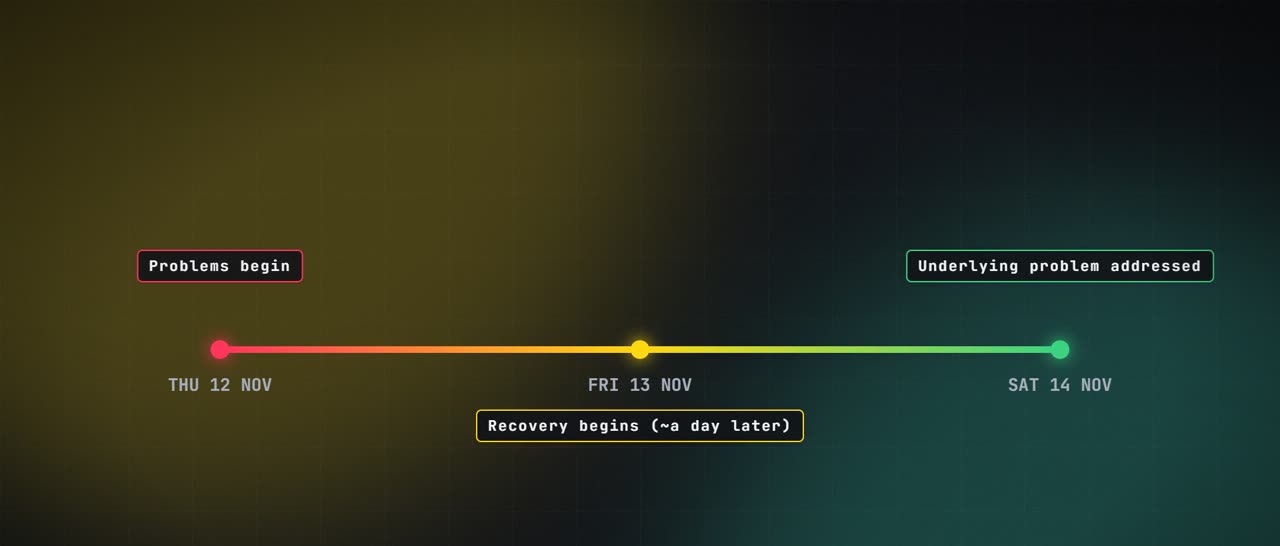
While services were recovering, Microsoft’s preliminary root cause said the incident “was introduced by an issue during an earlier network capacity upgrade that surfaced following a recent network change”. Its updates described a chain: a process on the affected servers that sets up secure connections became overwhelmed, the servers stopped processing requests, and failing automated health checks took more servers out of service. Engineers restarted servers, rolled back a recent network configuration change and validated an alternative health-check method, restoring service gradually.
RMIT University engineering academic Mark Gregory explained the domino effect to The Guardian: lose part of the server pool, and all the users try to reach the remaining servers, which overloads them — “a cascading problem”.

What the preliminary post-incident report adds
On 15 November Microsoft shared a preliminary post-incident report in the Microsoft 365 admin center. BleepingComputer and TNW, reporting separately, describe the same three causes:
- A dormant bug. A July update built for Microsoft 365’s network gateway servers contained a latent defect. It ran worldwide for more than three months without problems, but under certain load it caused lock contention inside an internal Windows process, exhausting a server’s CPU and memory until it stopped responding.
- A traffic surge. Microsoft Teams failed over to the gateway infrastructure that also carries Exchange Online, raising the load on those servers.
- Less spare capacity. An unrelated issue had already taken nearly 14% of the gateway’s server capacity offline.
Together, those conditions set the bug off. As each server stopped responding, traffic moved to the next one, which hit the same defect. “In less than two hours, the previously unknown defect was encountered across our fleet and rendered them unresponsive. At its lowest, more than 80% of servers were unresponsive,” Microsoft wrote, as quoted by BleepingComputer.
Why testing missed it
Microsoft said its normal load testing did not catch the problem because the tests ran on weaker hardware with fewer cores; the contention is worse on newer machines with more cores. And because the defect dated back months, “our normal rollback, flighting, and feature flags were unable to quickly revert the change,” wrote Charles Lamanna, Microsoft’s executive vice president for Copilot, agents and platform (TNW).
Why email was down longest
Teams, OneDrive, SharePoint and the Office apps could switch away from the faulty gateways and recovered sooner. Exchange Online could not make the same switch — which is why Outlook stayed down longest. Restarted servers were quickly overwhelmed again by backed-up traffic, so engineers wrote an update that returned the Windows code path to its previous state and applied it to groups of servers in turn.
Two explanations, one story
Are the “network capacity upgrade” explanation and the “July bug” explanation in conflict? Not necessarily. The first was Microsoft’s preliminary wording during the incident; the post-incident report describes the mechanism in more detail — a latent software defect, exposed when traffic shifted and spare capacity shrank. Microsoft said a final post-incident report would follow, expected around 20 November according to The Register (as cited by TNW). We will update this article if it changes the picture.
The lesson
By Microsoft’s account, no hacker was involved. Yet one company’s latent bug and a routine traffic shift still reached health services, courts and a climate summit. Rob Demain, chief executive of cybersecurity firm e2e-assure, called the outage “a stark reminder of how heavily we rely on a handful of big tech providers” (BBC).
In our view, the practical takeaways for organisations are unglamorous but important:
- Plan for the provider going dark. Know how you will communicate if email and chat disappear for a day — phone trees, a secondary channel, printed contact lists.
- Keep critical records reachable offline. The NHS fallback to paper records is a reminder that “the system is down” is a scenario to rehearse, not a surprise.
- Read the post-incident report. Cloud providers publish them for a reason; they show which services fail over and which do not — exactly what you need for your own continuity plan.
Sources checked 14 and 18 November 2026. Microsoft’s final post-incident report was still pending at the time of writing.